

EAC Certificate
EAC Certificate – last update 15.04.2016
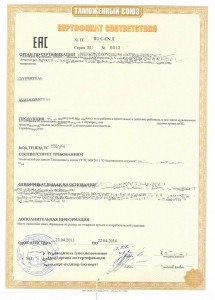
The EAC Certificate for the Customs Union EAC is one of two new EAC Certification documents introduced with the new reform of technical regulations (TR CU) in Russia, Belarus and Kazakhstan. The latter being the EAC Declaration for the Custom Union EurAsEC.
The first, predominant difference compared to the GOST R Certifications, is the validity extended to the three member countries of the Eurasian Customs Union: Russia, Belarus and Kazakhstan. Shortly to be extended to Armenia, Tajikistan and Kyrgyzstan.
The new rules have not entered into force simultaneously for all sectors of production, the legislation EAC in fact was scheduled in a three years time frame. The schedule is reported in the page devoted to the EAC regulations agenda.
In practice, for the EAC Certificate applicant, several differences are to be taken into consideration if compared with the issuance of a Certificate GOST R, a Declaration GOST R or a Certificate issued according technical regulations Gost TR.
New legislation on the EAC certificate applicant
A significant difference for foreign manufacturers, is the need to be supported in the request of the Certificate of conformity EAC, by a representative established in the territory of the Eurasian Customs Union. This means that it is not possible for a manufacturer, not registered in one of the countries of the Customs Union, to attain the Certificate EAC independently. The applicant may either be a subsidiary of the producer on the territory of the Custom Union EAC, an importer, a distributor or a company that provides representation services for EAC certification purposes. The name of the representative is therefore on the certificate and he is entitled to use the document at will, including to authorize its use by other entities, including the manufacturer, through a proxy.
The most important differences with regard to the issuance process of the document are concentrated undoubtedly in the verification procedure, which requires in some cases (depending on the type of product, the possibility to be easily transported and the validity of the certificate required): inspection and testing of the product at the production facility or shipment of samples to the laboratory. An analysis of the documentation is set constant.
The EAC certificates, once issued, can be found on the site of the Federal Agency RusAccreditation .
Ask for an offer or more information!
+44 203 630 13 04
+49 891 437 75 12
+7 499 653 52 59
+33 176 541 958
+39 02 947 509 21
+39 051 95 27 070
+34 911 798 351


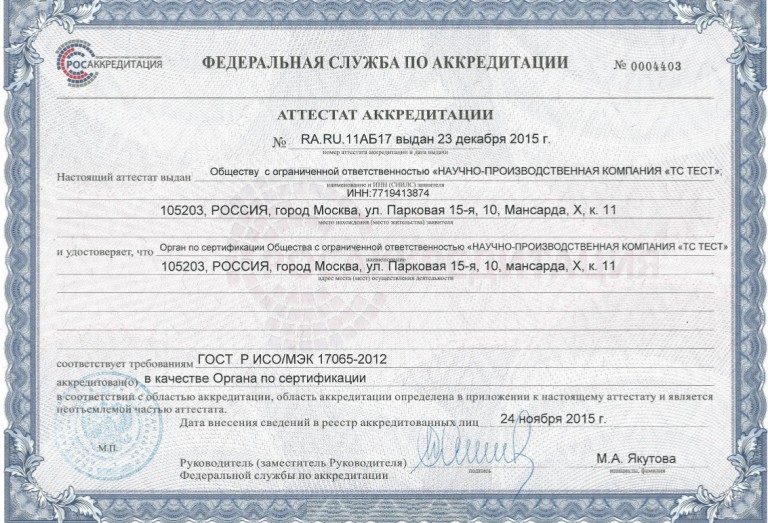
Necessary documentation to be provided in order to attain a Certificate of conformity EAC
The procedure for the issuance of the EAC Certificate results in a minimum schedule of two weeks depending on the technical regulations required to be issued according to, the completeness of the documentation provided and the level of cooperation from the representative company.
The EAC certificate is delivered on official paper, and generally a copy must be attached to the documents file required for customs clearance in Russia, Belarus and Kazakhstan, as well as being shown in original or in copy to the competent authorities in case of a request.
The use of EAC certificate is not limited, according to regulation, to business transactions with the representative, but it might be use for all transactions under the provision of the applicant’s proxy.
The Certificate of Conformity EAC provides various information including: the manufacturer’s name, the name of the applicant which, as mentioned, has to be established in the territory of the Eurasian Customs, the name of the certification body that issued the document, the name of product or products and its customs Code, the TR CU regulation to which the document refers, and finally the duration of the certificate, which can not exceed 5 years.
Among EAC certificates, two of the most significant documents are undoubtedly the EAC EX Certificate according to TR CU 12/2011 regulating equipment operating in potentially explosive atmospheres, and the EAC certificate for high pressure devices according to TR CU 032/2013. Both fundamentals for custom clearance and the periodical control of the Rostechnadzor.
Documents for the estimation:
Customs Code
Description of the product in Russian language
Drawings
Ingredients in the case of foods
Features of the operational facility
In order to issue the EAC certificate, in addition to the documents required for the estimate:
Sale agreement or proxy that connecting producer and representative
Founding act of the representative company
Any foreign certificates
Name of the producer
Certification request (provided by the certification body)
Operational documents: technical passport, user’s manual (in Russian language)
ISO processes
Technical features
Test protocol from the manufacturer
Certificates of compliance for materials and components
Certificates of conformity for the product
Other documents, which confirm directly or indirectly that the products conform to the safety requirements of technical regulations:
Photos
Drawings / diagrams

Mandatory sample importation for EAC certifications
Many businesses, large and small, have a huge source of great ideas that can help them improve, innovate, and grow, and yet so many of these companies never think of using this amazing corporate asset. What is this highly valuable asset? Its own people.
10 April 2019
TR CU 010/2011 on the safety of machinery and equipment
Many businesses, large and small, have a huge source of great ideas that can help them improve, innovate, and grow, and yet so many of these companies never think of using this amazing corporate asset. What is this highly valuable asset? Its own people.
11 October 2017
EAC Certificate and EAC Declaration: what to choose and when?
Many businesses, large and small, have a huge source of great ideas that can help them improve, innovate, and grow, and yet so many of these companies never think of using this amazing corporate asset. What is this highly valuable asset? Its own people.
22 January 2016
EAC technical regulations schedule
TR CU 006/2011 on the safety of fireworks;
TR CU 019/2011 on the safety of personal protective equipment;
TR CU 005/2011 on the safety of the packaging;
TR CU 007/2011 on product safety for children and teenagers;
TR CU 008/2011 on the safety of toys;
TR CU 009/2011 on the safety of perfumery and cosmetics;
TR CU 017/2011 on the safety of products of light industry (clothing);
TR CU 013/2011 on the quality of the automotive and aviation fuel, gasoline, diesel and marine fuel, jet fuel and fuel oil;
TR CU 004/2011 on the safety of low voltage equipment;
TR CU 010/2011 on the safety of machinery and equipment;
TR CU 011/2011 on the safety of lifts;
TR CU 012/2011 on the safety of equipment for potentially explosive atmospheres;
TR CU 016/2011 on the safety of machines operating on gaseous fuel;
TR CU 020/2011 on electromagnetic compatibility of technical devices;
TR CU 015/2011 on the safety of grain;
TR CU 021/2011 on food safety;
TR CU 022/2011 on the rules of marking on food products;
TR CU 023/2011 for fruit juices and products derived from fruits and vegetables;
TR CU 024/2011 for products obtained from animal and vegetable fats and oils;
TR CU 027/2012 on dietetic foods, including dietary foods for special medical purposes;
TR CU 029/2012 on the safety of food additives, flavorings and processing aids;
TR CU 026/2012 on the safety of vessels up to 20 meters;
TR CU 032/2013 on the safety of pressure equipment;
TR CU 030/2012 oils and greases, lubricants and special fluids;
TR CU 033/2013 on the safety of milk and dairy products;
TR CU 034/2013 on the safety of meat and meat products;
TR CU 025/2012 on the safety of furniture and furnishings;
TR CU 028/2012 on the safety of explosive material and explosive-based products;
TR CU 001/2011 on the safety of railway rolling stock;
TR CU 002/2011 on the safety of high-speed rail transport;
TR CU 003/2011 on the safety of rail infrastructure;
TR CU 018/2011 on the safety of motor vehicles;
TR CU 014/2011 on road safety.
TR CU 031/2012 on the safety of agricultural and forestry tractors and their trailers.