
 Deutsch
 Español
  Français
 Italiano
 Русский
 简体中文
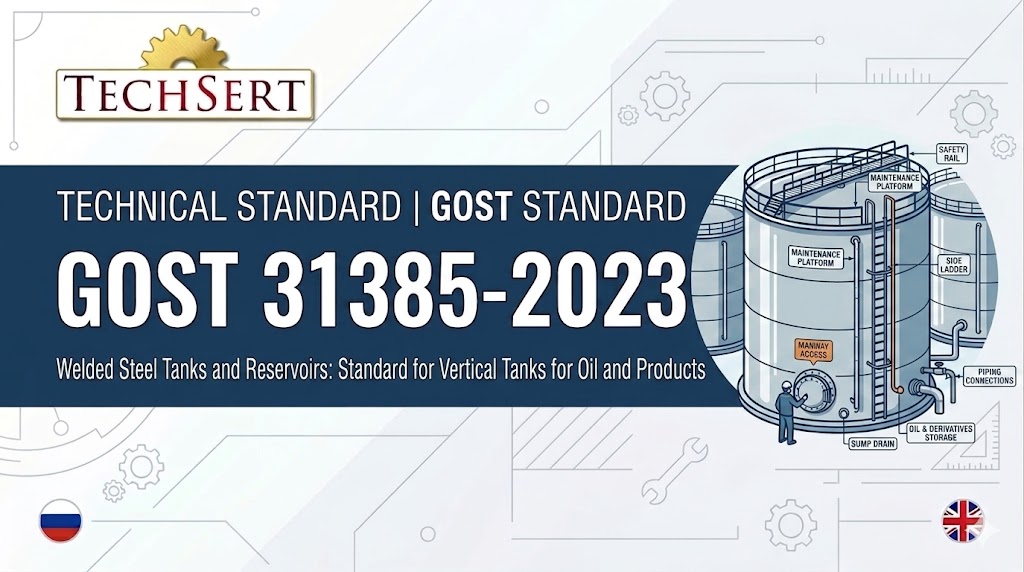
简体中文GOST 31385-2023: Vertical Cylindrical Steel Tanks for Oil and Oil Products
Document Overview
GOST 31385-2023 specifies the overarching technical requirements for the engineering, fabrication, assembly, and testing of vertical cylindrical steel tanks ranging from 100 m³ to 120000 m³ nominal capacity. These storage vessels are vital for the extraction, transportation, processing, and long-term storage of crude oil and refined petroleum products. The standard thoroughly classifies tanks into various levels of responsibility (KS-3a, KS-3b, KS-2a, KS-2b) and outlines stringent mandates for structural integrity, seismic resilience, corrosion allowance algorithms, and hydrostatic proofing to guarantee operational safety under temperature gradients between -65 °C and +160 °C.
Gap Analysis: GOST 31385-2023 vs. API 650 / EN 14015
- Manufacturing Methods: Unlike API 650 which predominantly emphasizes conventional plate-by-plate assembly, GOST 31385-2023 extensively standardizes the roll-building (coiling) method for tanks up to 20000 m³ and plate thicknesses up to 18 mm. This drastically alters factory-to-field welding ratios and logistics.
- Responsibility Classification: GOST stratifies storage tanks into functional classes (KS-3a for > 50000 m³, down to KS-2b for < 1000 m³). These classes directly mandate the multiplier for safety factors ($\gamma_n$) ranging from 1.00 to 1.25, and dictate specific NDT volume percentages—a tiered approach not universally mirrored in EN 14015.
- Roof Tolerances: The standard incorporates rigid criteria for easily droppable roof decks (frangible roofs), limiting radial beam inclination to a maximum of 9.46° (slope 1:6) specifically for tanks with diameters exceeding 15 m.
Approved Steel Grades for Primary Structures (Groups A & B)
| GOST Grade | ASTM/EN Equivalent (Approx.) | Chemical Composition (Max %) | Mechanical Properties (Min Yield MPa) | Design Temp Range |
|---|---|---|---|---|
| St3ps5 | S235JRG2 | C: 0.22, S: 0.040, P: 0.030 | 235 MPa | > -20 °C |
| St3sp5 | S235J2G3 | C: 0.22, S: 0.040, P: 0.030 | 245 MPa | > -20 °C |
| 09G2S-7 | P355GH | C: 0.12, S: 0.035, P: 0.030 | 345 MPa | > -40 °C |
| 09G2S-8 | A516 Gr. 55 | C: 0.12, S: 0.035, P: 0.030 | 345 MPa | > -40 °C |
| 09G2S-9 | A516 Gr. 60 | C: 0.12, S: 0.035, P: 0.030 | 345 MPa | > -50 °C |
| 09G2S-20 | S355J2 | C: 0.12, S: 0.025, P: 0.035 | 345 MPa | > -60 °C |
| 10KhSND-12 | S355K2W | S: 0.010 (VO), CE <= 0.43 | 390 MPa | > -60 °C |
| 10KhSND-15 | S355K2W | S: 0.010 (VO), CE <= 0.43 | 390 MPa | > -65 °C |
| 10G2SB | API 2H Gr. 50 | S: 0.010 (VO), CE <= 0.44 | 440 MPa | > -60 °C |
| 10G2FB | X65 | S: 0.006 (VO), CE <= 0.43 | 460 MPa | > -60 °C |
| 08G1NFB | API 2W Gr. 60 | S: 0.006 (VO), CE <= 0.43 | 460 MPa | > -60 °C |
| 12GN2MFAYu-U | S690QL | S: 0.010 (VO) | 590 MPa | > -60 °C |
| 12Kh18N10T | AISI 321 | C: 0.12, Cr: 17-19, Ni: 9-11 | 276 MPa | High Temp / Corrosive |
| 10Kh17N13M2T | AISI 316Ti | C: 0.10, Cr: 16-18, Mo: 2-3 | 276 MPa | High Temp / Corrosive |
| 08Kh18N10T | AISI 321H | C: 0.08, Cr: 17-19, Ni: 9-11 | 252 MPa | High Temp / Corrosive |
| 03Kh18N11 | AISI 304L | C: 0.03, Cr: 17-19, Ni: 10-12 | 240 MPa | Cryogenic / Corrosive |
Note: Steel utilized for primary structures (Group A & B) must be fully killed steel. Carbon equivalent (CE) strictly bounded to <= 0.45% for steels with yield strengths under 390 MPa to guarantee weldability.
Strict Structural Design Parameters
- Tank Bottom Design: Minimum plate thickness is set to 4.0 mm for tanks < 2000 m³, and 6.0 mm for tanks >= 2000 m³ (excluding corrosion allowance). Annular ring plates must radially project beyond the external shell profile by 50 to 100 mm. Bottom slope generally specified at 1:100 outward (1:30 toward the center for aviation fuel to allow complete drainage).
- Tank Shell Profile: Computed wall thickness dynamically scales based on hydrostatic, seismic, and internal gas pressure (up to 5000 Pa). Maximum nominal thickness limit is clamped at 40 mm. Minimum allowable plate thickness spans from 4.0 mm (D <= 10 m) to 12.0 mm (D > 65 m).
- Geometric Deviation Limits:
- Plumbness (Verticality): Deviation of shell generatrix from the vertical axis must not exceed 1/200 of the total shell height ($H$).
- Radial Geometry: Internal diameter variance (measured at 300 mm elevation) restricted to 0.005R (D <= 12 m), stepping down to 0.0015R (D > 40 m).
- Weld Deplanation: Misalignment of butt joints capped at 1.0 mm for plates <= 10 mm thick, and 10% of thickness (up to 3.0 mm maximum) for plates > 10 mm.
- Floating Roof / Pontoon Clearance: The nominal radial gap separating the tank shell from the pontoon or floating roof rim is strictly configured at 200 mm (allowable variance ±100 mm).
Quality Assurance and Verification Matrix
- Visual and Measuring Control (VT): 100% compulsory coverage for all structural welds, removing arc strikes and undercuts (max undercut depth 0.5 mm for vertical welds of Class KS-3a/KS-3b).
- Bottom Plate Integrity: Leak-proofing verification explicitly requires Vacuum Box Testing traversing all lap and butt welds on the bottom plates.
- Radiographic Testing (RT) Volumes: Scaled directly by the tank’s responsibility class:
- Class KS-3a (V > 50000 m³): Requires 100% RT coverage for vertical joints in the 1st and 2nd courses, 50% for 3rd and 4th, and 25% thereafter.
- Class KS-2a (1000 – 10000 m³): Vertical joint RT volumes set at 20% (1st/2nd courses), 5% (3rd/4th), down to 2% for upper rings.
- Note: Any rolled assembly joints (coiling method) for V >= 1000 m³ dictate 100% RT coverage unconditionally.
- Ultrasonic Testing (UT): Authorized as a primary substitute or supplementary matrix for volumetric defect detection in shell butt joints and the critical shell-to-bottom chime connection (when full penetration is engineered).
- Hydrostatic Testing Durations: The hydraulic static holding stage—post full water charge—requires a 24-hour stabilization phase for tanks under 10000 m³, 48 hours for 10000-20000 m³, and 72 hours for tanks exceeding 20000 m³.
Download the Full Technical Documentation
Secure your comprehensive, engineering-grade translation of GOST 31385-2023. Enter your contact details below to directly access the unabridged PDF layout containing complete dimensional matrices, nozzle constraints, and structural calculus.
china@gostrussia.com
india@gostrussia.com
+44 203 630 13 04
+49 891 437 75 12
8 800 500 31 57
+39 02 947 509 21
+34 911 798 351