
 Deutsch
 Español
  Français
 Italiano
 Русский
 简体中文
简体中文EAC Certification for Heavy Industry: 2026 Technical Compliance Guide
The heavy industry sector encompasses an expansive range of products, from massive processing lines to intricate hydraulic components. In 2026, the regulatory landscape of the Eurasian Economic Union (EAEU) requires a sophisticated, multi-regulation approach to ensure market access. Certification for this sector is governed by several distinct technical regulations, and the resulting legal documentation—whether an EAC Declaration or an EAC Certificate—depends entirely on the specific technical parameters and hazardous risks associated with the equipment. For equipment intended for use at Hazardous Production Facilities (HPF) where laboratory testing of a full assembly is not technically feasible, the 5d scheme for the EAC Declaration is utilized. This specific scheme requires the involvement of an accredited certification body and is often supported by an Industrial Safety Expertise (RTN Expertise) to confirm that the technical complex meets the rigorous safety requirements of Rostekhnadzor.

The Mandatory Certification Framework for Industrial Machinery
Most industrial machinery and equipment must undergo compulsory conformity assessment before being sold or commissioned in Russia and the wider EAC Customs Union. For standard industrial equipment, the EAC Declaration is the most common path to compliance, typically requiring adherence to three “pillar” regulations: TR CU 010/2011 for machinery safety, TR CU 004/2011 for low voltage safety, and TR CU 020/2011 for electromagnetic compatibility. In complex industrial scenarios, particularly those involving customized or large-scale machinery, the 5d scheme allows for the registration of a declaration based on a “Type Examination” performed by a notified body. This is frequently paired with a comprehensive Industrial Safety Expertise—a technical audit that evaluates the equipment’s operational safety and compliance with federal industrial safety norms, ensuring the machinery is ready for unimpeded commissioning at high-risk industrial sites. TechSert Group facilitates this process through accredited laboratory testing, specialized expertise coordination, and rigorous Technical Passport and Safety Justification preparation.
1. High-Risk & Specialized Industrial Certification
Equipment operating in potentially explosive environments—such as mines, refineries, or chemical plants—requires a mandatory EAC EX Certificate. While conceptually similar to the European ATEX directive, TR CU 012/2011 has specific administrative and linguistic requirements that cannot be replaced by Western certifications. The certificate must be registered in the official EAEU database following a successful facility audit and laboratory testing of explosion-proof protection types.
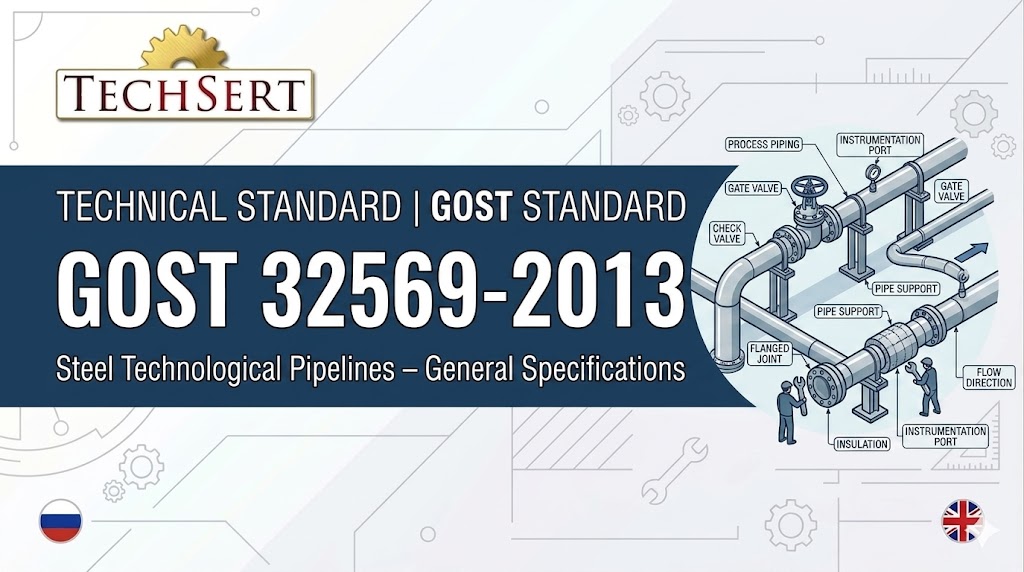
Vessels, boilers, pipes, and valves operating under pressure fall under TR CU 032/2013 on the safety of pressure equipment. This regulation was redacted along the lines of the European PED but includes distinct calculation methods for safety and strength.
- Hydraulic Elements: Pipes, flanges, and fittings generally do not require mandatory certification unless the combination of pressure ($P$), diameter ($DN$), and fluid type places them in Category 1, 2, 3, or 4 of the regulation.
- Voluntary GOST R: In cases where TR CU 032 does not apply, TechSert recommends attaining a voluntary GOST R mark to improve competitiveness in international tenders.
2. Electrical Systems & Gas-Fueled Equipment
Electrical infrastructure and gas-propelled industrial units are subject to strict safety attestation:
- Low Voltage Switchboards & Control Panels: These are subject to mandatory EAC Certification (not just a declaration) according to TR CU 004/2011 and TR CU 020/2011. This ensures that the heart of the industrial control system is protected against electrical hazards and interference.
- Gaseous Fuel Machines (TR CU 016/2011): Professional kitchen equipment, burners, and industrial heaters fueled by gas must comply with TR CU 016/2011 in addition to machinery and electrical safety standards. The resulting document may be either a certificate or a declaration based on the appliance’s thermal power.
3. Legal Metrology: PAC Pattern Approval
Measuring instruments (flow meters, pressure gauges, scales) intended for legal metrology must attain a GOST R Pattern of Approval (PAC), also known as a Metrological Certificate. Even if the device holds harmonized OIML certifications, it must be registered in the Russian Federal Information Fund for Ensuring the Uniformity of Measurements to be used in commercial transactions or safety-critical processes.
High-Impact Technical Regulations (TR CU) for Heavy Industry
The heavy industry sector is primarily governed by the following directives:
- TR CU 004/2011: Safety of low voltage equipment.
- TR CU 010/2011: Safety of machinery and equipment.
- TR CU 012/2011: Safety of equipment for potentially explosive atmospheres (EAC EX).
- TR CU 016/2011: Safety of machines operating on gaseous fuel.
- TR CU 019/2011: Safety of Personal Protective Equipment (PPE).
- TR CU 020/2011: Electromagnetic compatibility of technical devices.
- TR CU 030/2012: Safety of lubricants, oils, and special fluids.
- TR CU 032/2013: Safety of pressure equipment.
2026 Sanctions & Export Feasibility
In 2026, heavy industry products are frequently subject to dual-use restrictions. TechSert performs a mandatory HS Code Screening for all industrial machinery projects to ensure the equipment is not blocked by international sanctions before proceeding with the technical certification.
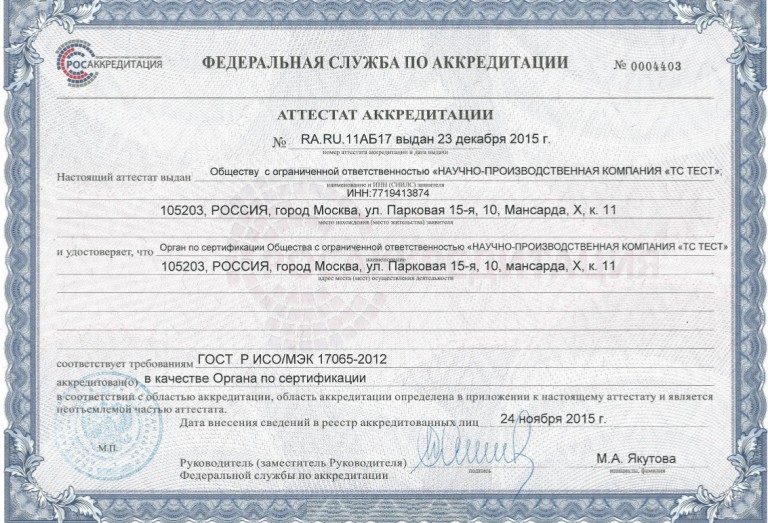
TechSert Group, thanks to its team of high-quality professionals, helps companies in more than 70 countries to prepare all necessary documentation, including the Technical Passport and Safety Justification, to attain GOST and EAC certifications. Our in-house certification body ensures the highest level of quality at every step.
EAC and Gost Certification News

Exporting to Russia 2026: Strategic Non-Sanctioned Key Sectors
Many businesses, large and small, have a huge source of great ideas that can help them improve, innovate, and grow, and yet so many of these companies never think of using this amazing corporate asset. What is this highly valuable asset? Its own people.
10 March 2026
EAC Certificate or Declaration? The Complete 2026 Guide to Eurasian Compliance
Many businesses, large and small, have a huge source of great ideas that can help them improve, innovate, and grow, and yet so many of these companies never think of using this amazing corporate asset. What is this highly valuable asset? Its own people.
10 February 2026
The EAC certifications for the Oil & Gas sector in the Eurasian Economic Union
Many businesses, large and small, have a huge source of great ideas that can help them improve, innovate, and grow, and yet so many of these companies never think of using this amazing corporate asset. What is this highly valuable asset? Its own people.
27 October 2025Mandatory sample importation for EAC certifications
Many businesses, large and small, have a huge source of great ideas that can help them improve, innovate, and grow, and yet so many of these companies never think of using this amazing corporate asset. What is this highly valuable asset? Its own people.
10 April 2019
EAC and Gost Certifications by Product

china@gostrussia.com
india@gostrussia.com
+44 203 630 13 04
+49 891 437 75 12
8 800 500 31 57
+39 02 947 509 21
+34 911 798 351